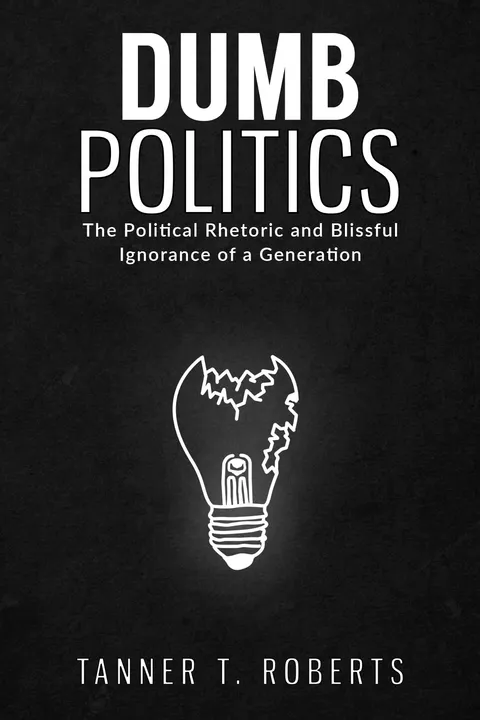
Dumb Politics
The Political Rhetoric and Blissful Ignorance of a Generation
In “Dumb Politics,” Tanner T. Roberts fearlessly tackles the erosion of rational discourse in modern political debate. With sharp insight and biting humor, Roberts exposes how emotion-driven arguments and virtue signaling have replaced empirical evidence and constructive dialogue in our political landscape.
This provocative book delves into the heart of our most pressing issues, from education and economics to culture and immigration, revealing how “dumb politics” has taken root across generations. Roberts argues that the death of individualism and the obsession with governing rather than empowering citizens have led to a dangerous political climate where feelings trump facts.
“Dumb Politics” is a wake-up call for anyone concerned about the future of democratic discourse. Roberts challenges readers to question the status quo, think critically, and resist the allure of simplistic political narratives. With endorsements from influential voices like Dinesh D’Souza and Lars Larson, this book promises to spark crucial conversations about the state of our political system.
Prepare to have your assumptions challenged and your mind opened. “Dumb Politics” is an essential read for those who believe in the power of reason and seek to understand the forces shaping our political reality. Don’t underestimate the impact of ignorance on our society – arm yourself with the knowledge to combat it.
Editorial Review ★★★★★ A Sharp Critique of Modern Political Discourse Tanner T. Roberts’ “Dumb Politics” delivers a bold and incisive examination of contemporary political discourse that challenges readers to reconsider how we engage in civic dialogue. Through a combination of pointed analysis and mordant wit, Roberts constructs a compelling argument about the deterioration of rational political discussion in modern America.
The book’s greatest strength lies in its unflinching analysis of how emotional reasoning has come to dominate political debate. Roberts demonstrates particular skill in dissecting complex political issues – from education to immigration – while revealing how fact-based discussion has often been supplanted by emotional appeals and virtue signaling. His examination of this shift is both thorough and thought-provoking, supported by concrete examples from contemporary political discourse.
Particularly noteworthy is Roberts’ exploration of the relationship between individualism and governance. Through careful analysis, he builds a persuasive case for how the balance between individual empowerment and collective governance has shifted in recent decades. While readers may not agree with all of his conclusions, his argument that modern political discourse often prioritizes feelings over empirical evidence is well-documented and deserves serious consideration.
The narrative gains considerable momentum when examining specific instances of what Roberts terms “dumb politics” across generations. His analysis of how political narratives evolve and persist provides valuable insights into the mechanics of modern political discourse. The author’s wit serves as an effective tool for illuminating serious issues without diminishing their importance.
Where the book truly excels is in its call for a return to reason-based political dialogue. Roberts doesn’t merely criticize; he offers constructive suggestions for how readers can engage more effectively in political discourse. His emphasis on critical thinking and empirical evidence provides a practical framework for evaluating political arguments and narratives.
“Dumb Politics” succeeds in being both entertaining and substantive, maintaining scholarly rigor while remaining accessible to general readers. The endorsements from prominent conservative voices like Dinesh D’Souza and Lars Larson underscore the book’s impact within political commentary circles, though readers across the political spectrum will find value in its analysis of how emotion-driven arguments can undermine constructive dialogue.
Roberts emerges as a sharp observer of political culture, offering insights that transcend partisan divisions to examine the fundamental nature of political discourse itself. Whether one ultimately agrees with his conclusions or not, his analysis of how emotional appeals and virtue signaling have influenced modern political debate provides valuable perspective on contemporary civic discourse.
For readers seeking to understand the forces shaping modern political dialogue, “Dumb Politics” offers a thought-provoking analysis that encourages critical examination of how we engage in political discussion. Roberts’ work stands as both a critique of current practices and a call to action for more reasoned political discourse.